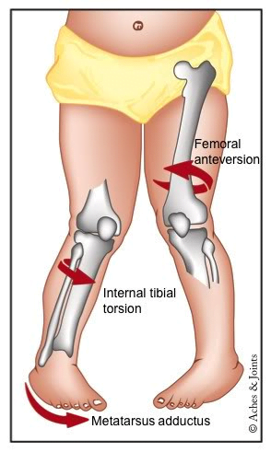
In-toeing is a common condition in toddlers and young children in which the foot points inwards whilst they are weight-bearing. Generally, it is painless and can be normal, and usually improves as children grow. In-toeing occurs because the bones in the leg rotates inwards. There are 3 common causes of in-toeing.
Metatarsus Adductus – the foot is turned inwards
Generally, the outside border of the foot is straight. In Metatarsus Adductus the foot curves inwards. It can often be mistaken as a mild clubfoot deformity, but the two conditions are very different. There is no identifiable cause of Metatarsus Adductus, but it is thought to be related to the position of the baby whilst in the mother’s uterus. It usually improves without any treatment by the age of two-three, but often shoe inserts or casts may be recommended. Gentle exercises can also help improve the foot position.

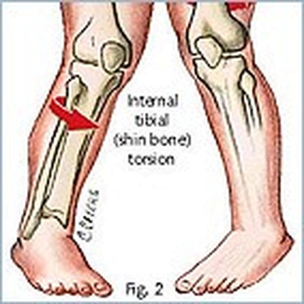
Internal Tibial Torsion – the shins rotate inwards
In internal tibial torsion, the tibia (the long bone between your knee and ankle) rotates inwards and is very common in infancy and childhood. It is thought to be caused by the position of the leg whilst in the mother’s womb, and the tibia usually ‘twists’ to help the legs fit within the womb. It usually corrects without treatment by the age of eight and requires no special exercises, braces and shoes.
Femoral Anteversion – the thigh bone twists inwards
In femoral anteversion, the femur (thighbone) twists and turns inwards. In almost all children, the femur will gradually correct and untwist. There is no special braces or shoes to help this, however, some gentle exercises can help improve the positioning of the hip. We also recommend children with femoral anteversion do not sit in the ‘W’ position as this can increase the risk of long-term femoral anteversion.
Symptoms of In-Toeing
Most children with in-toeing have no pain or functional issues. Sometimes parents note their children often trip frequently or walk/run with their feet pointed inwards.
Examinations
No special tests are required to exam a child who has a suspected in-toeing condition. Often, a thorough history regarding the birth history and developmental milestones is required, and any history of limping/pain. Physical examination including watching your child walk and run, and performing range-of-motion testing on ankles/hip/knees will also be required. Testing of muscle tightness, nerve and muscle function and coordination is also vital.
When is in-toeing abnormal?
If there is a developmental delay, pain, limping, asymmetry (in-toeing on one leg only) or abnormal gait then other tests may be required. This can include imaging (usually x-rays).
If femoral anteversion or tibial torsion is still present between the ages of 11-15 and causing problems with walking and running, surgery may be considered to help cut and rotate the bone. This is very rarely required in otherwise normal children with femoral anteversion/tibial torsion.